A personal guarantee in a merchant cash advance (MCA) makes you personally responsible for the debt if the business cannot pay. It is common, is usually signed alongside the company's own agreement, and can reach personal assets beyond the business. Knowing exactly what you signed, and what happens next, is the first step to a workable plan.
What to do first
5 steps · most of it freeTick them off as you go. Saved only in this browser, never sent anywhere.
What an MCA Personal Guarantee Actually Says #
A merchant cash advance works differently from a conventional loan. The business sells a share of its future sales, often through card receipts or daily bank deposits, in exchange for a lump sum. The funder then collects a fixed percentage of those sales until a set total is repaid.
The personal guarantee is a separate document. In it, you promise to cover the remaining balance if the business defaults. Read four parts closely:
- Trigger events. Default definitions are often broad. A missed remittance is the obvious one, but others can count, such as a change in ownership, a closed bank account, or a significant drop in deposits.
- Amount. Look for whether the guarantee covers the full remaining balance, plus fees and sometimes collection costs. Ask whether it is capped or unlimited.
- Other signers. Check whether a spouse or partner is asked to sign.
- Legal remedies. Some MCA contracts include a confession of judgment, which lets the funder obtain a court judgment without a trial. Several states restrict or ban these clauses. Ask a business attorney in your state how the clause applies to you.
Signing the guarantee does not mean the funder will automatically pursue your personal assets. It does mean they have the right to, if the contract's terms are met.
How It Differs From a Personal Guarantee on a Bank or SBA Loan #
Bank and SBA loans also require personal guarantees, and owners should not assume they are harmless. On SBA 7(a) loans, anyone owning 20% or more of the business is generally required to guarantee the loan.
The difference lies in the structure. A bank term loan has a fixed rate, a set repayment schedule, and a defined end date. Its guarantee usually attaches to a loan with those known terms, and it often comes with collateral pledged by the business. An MCA guarantee attaches to a purchase of future receivables. Payments move with your sales, the cost is quoted as a factor rate (for example, 1.25 over 8 months ≈ 65–75% APR), and default triggers can be broader.
Here is how the main options compare:
| Option | Typical cost | Speed | What it needs |
|---|---|---|---|
| Merchant cash advance | Priced as a factor rate: for example, a 1.25 factor over 8 months works out to roughly 65–75% APR | Often within days | Recent card sales or bank deposits, usually several months of statements |
| Bank term loan | Interest rate set by credit and time in business. Often well below MCA pricing for qualified borrowers | Usually weeks | Time in business, credit history, financial statements, often collateral |
| SBA 7(a) loan | Rate capped by an SBA formula tied to prime | Often one to three months | Full documentation, personal guarantee from owners with 20% or more, eligibility rules |
| Business line of credit | Interest on the drawn balance, plus any fees | Days to weeks once approved | Revenue history, credit review, possibly a personal guarantee |
A bank or SBA loan is the better tool if you can qualify and your timeline allows the paperwork. It is not an option if you need cash this week and cannot document your revenue. For those cases, an MCA may be the only route available, and the guarantee terms matter more.
When Owners Usually Run Into Trouble With It #
Most problems follow a few patterns:
- Seasonal revenue. A daily or weekly remittance that works in a strong month can drain cash in a slow one.
- Stacking. Taking a second advance to cover the first one raises the total owed and often shortens the time you have to recover.
- An unrelated default. An owner may trigger the guarantee through a bank account closure or a change in ownership, not a missed payment.
- Closing the business. Closing the business does not automatically cancel the guarantee. The debt can follow you.
Recognizing these patterns early gives you more room to act.
What Happens If the Business Can't Keep Up With Payments #
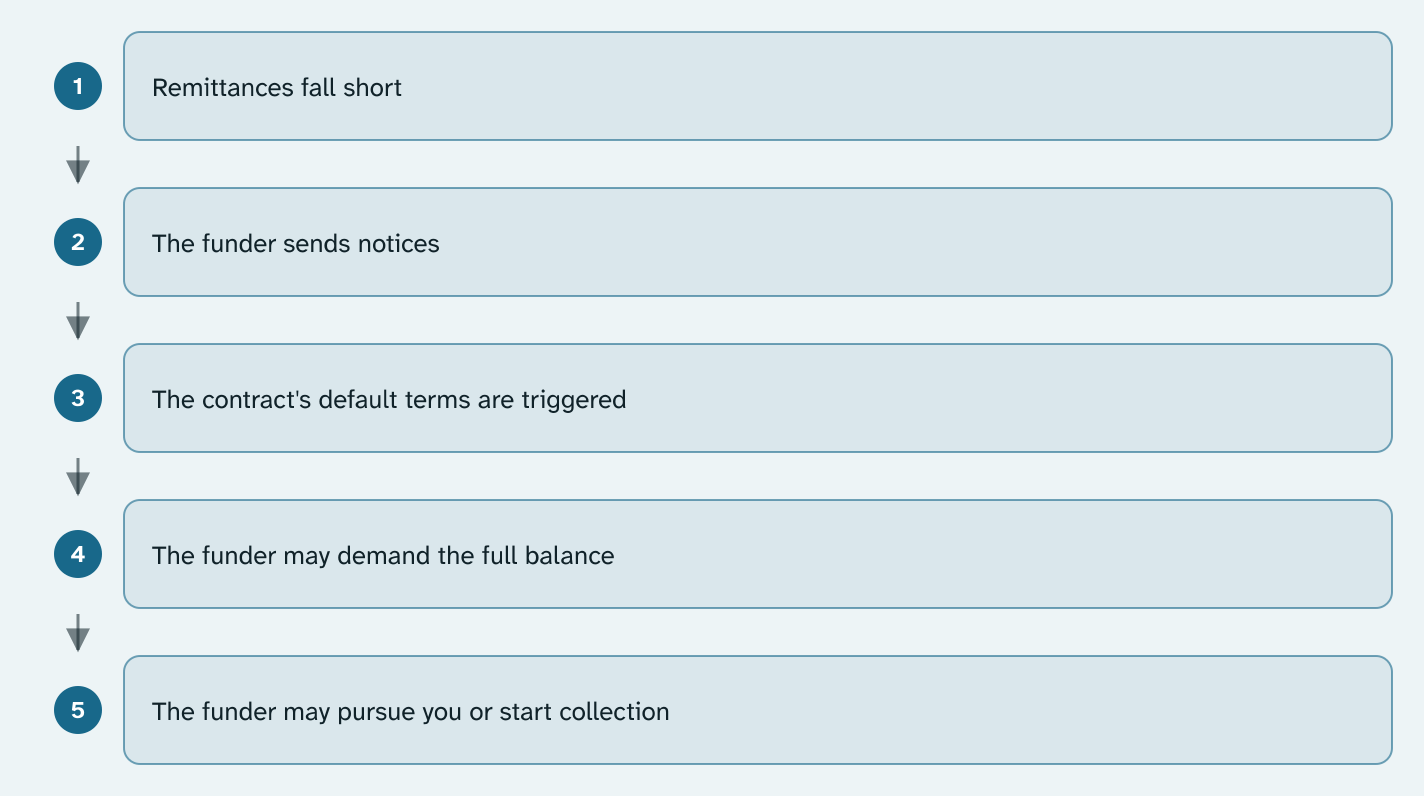
The usual sequence runs like this. Remittances fall short. The funder sends notices. The contract's default terms are triggered. The funder may then demand the full balance under the agreement, pursue you as guarantor, or start collection proceedings, which can include a court judgment.
Most funders would rather negotiate than litigate, but the timing matters. Owners who talk to the funder before a default is declared usually have more options than those who wait for a demand letter.
Signing Checklist for the Next Funding Decision #
Before you sign any future agreement, check the following:
- Whether the guarantee is limited or unlimited, and the exact dollar cap if there is one
- Every event that triggers personal liability, not only missed payments
- Whether a confession-of-judgment clause is included, and how your state treats it
- Whether a spouse or partner is being asked to sign
- The total amount you will repay in dollars, not just the factor rate
- The APR equivalent for the cost, so you can compare it with other options
- A copy of every signed document, kept somewhere you can find it
- A plan for a slow month, including how much cash you would need to cover one remittance
What is an MCA personal guarantee worth to my business? #
Quick answer: The guarantee is a condition of getting the advance, and it carries real risk. Its value depends on whether the advance solves a problem you can repay. If it does, the guarantee is one term among many. If it doesn't, the guarantee can put your personal assets on the line for a shortfall your business cannot cover.
Does an MCA personal guarantee make me personally liable for the full balance? #
It can. Whether you owe the full balance depends on the wording of the guarantee. Some are capped at a set amount. Others cover the entire remaining balance plus fees and collection costs. Check the cap, the trigger events, and whether the guarantee is joint with other owners. Only a review of your signed documents, ideally with an attorney, will tell you what you are personally on the hook for.
Can an MCA personal guarantee be enforced if my business closes? #
Often, yes. Closing the business does not automatically cancel a personal guarantee. If the contract treats closure or a change in ownership as a default event, the funder may have the right to pursue you for the remaining balance. Some owners negotiate a settlement after closure. Speak with an attorney before you make any payment or sign any new agreement that addresses the debt.
Is an MCA personal guarantee the same as a personal guarantee on a bank loan? #
Not quite. Both make you personally responsible if the business defaults. The difference is in structure. A bank loan has a fixed rate, a set schedule, and an end date, and it often involves collateral. An MCA ties repayment to your sales and typically uses a factor rate (for example, 1.25 over 8 months ≈ 65–75% APR). Its default triggers can be broader, which is why reading the trigger section matters so much.
What should I do if my business can't make MCA payments and I have a personal guarantee? #
Contact the funder in writing as early as you can. Describe the shortfall, share the numbers, and ask what adjustments are available. Do not take a new advance to cover the gap without a clear repayment plan. Then get a business attorney in your state to review the guarantee and the default terms. Early, documented communication usually leaves you with more options.
Can I negotiate or remove a personal guarantee on an MCA? #
Sometimes you can negotiate its terms, such as a lower cap or a narrower trigger list, but removing it after signing is rare. The best time to negotiate is before you sign. Ask whether the guarantee can be limited, and get any agreed change in writing. Once a default has occurred, a settlement may be possible, but it is not guaranteed and usually requires professional help.
Where a Personal Guarantee Makes Sense, and Where It Doesn't #
A personal guarantee on a merchant cash advance makes sense when you have a clear, sized need, steady sales that cover the remittance with room to spare, and a full understanding of the trigger events. It does not make sense when you are funding a shortfall with no repayment source, when you have not read the default terms, or when you are already behind and considering another advance to catch up.
If your numbers support repayment and you have reviewed the guarantee, you can start your request with Pemberton Business Resolution's network of funding partners. Have your signed documents and last three to six months of statements ready first.
Sources #
Where to from here
This guide is general information, not advice for your situation. Costs are typical ranges, not offers; the terms that apply to you are only those in an agreement you sign. If a lawsuit, judgment or lien notice has arrived, get an attorney involved. How this site is paid.